Visibility into selected blind-state events
A correctly matched BLE sensing and gateway setup can surface supported states for designated blinds, reducing dependence on scattered status notes. It does not itself verify safe isolation.

Operational visibility for configured isolation-blind workflows during refinery and petrochemical turnarounds. ip³Smart Blinds uses BLE edge sensors with a compatible BLE-enabled LTE gateway to surface selected blind-state events. Device suitability, site classification, connectivity and workflow fit are validated during solution design.

Evaluate how configured visibility could support your shutdown workflow. This information does not replace approved field checks, isolation/LOTO or permit procedures.
Identify representative blinds, intended states and the stages of your shutdown cycle to evaluate.
Evaluate selected blind-state events supported by the actual sensor model, mounting and gateway configuration.
Define which configured events should reach which roles and how escalation will be evaluated; delivery is not guaranteed.
Plan blind-to-joint associations and time-stamped history, subject to available device and platform capabilities.
Identify desired handoffs to existing processes. Connections to permit, LOTO or other systems are not confirmed integrations.
Review the sensor, gateway and complete installation against the site's classification and jurisdiction before selection.
Connect the right blind sensors, BLE-enabled gateways and event workflows to help teams see what needs attention during complex plant turnarounds. Each function requires confirmation against actual hardware and site procedures.
A correctly matched BLE sensing and gateway setup can surface supported states for designated blinds, reducing dependence on scattered status notes. It does not itself verify safe isolation.
Where device capabilities and event routing support it, configured movement or state changes can be flagged for the right team to investigate under existing site procedures.
A configured register and available event history can help teams associate observed events with particular blind IDs or pipe-joint locations during a turnaround.
Present selected sensor events to supervisors and contractors as supplemental operational context. Permit-to-work and lockout/tagout decisions remain in the site's approved systems and procedures.
Evaluate LTE gateways with BLE support for sun-exposed outdoor positions or locations where a battery-powered approach is more practical; verify power, maintenance and network fit.
Available hazardous-area BLE sensing options can be considered for classified facilities, subject to exact variant certification and approval of the complete installation.
Connected monitoring supplements, but never replaces, physical field verification, permit-to-work requirements, approved isolation checks or lockout/tagout procedures.
Use an anonymous representative scope to evaluate the stages of your shutdown cycle without disclosing customer or site identifiers.
A deployment assessment needs the scope, classification, environment, connectivity and governance requirements below. Suitability and approvals remain subject to project-specific review; submitting an inquiry is not deployment approval.
Select measurable project criteria and review thresholds; these are evaluation criteria, not promised outcomes.
Both options require a compatible BLE-enabled LTE gateway and supported BLE sensor profiles. Select hardware only after reviewing the actual model, site, network, power and environmental constraints.

A solar-powered LTE + BLE gateway option for locations where solar exposure, mounting, power budget and connectivity meet the selected model’s requirements. Installation and IT/OT review remain project-specific.

A battery-powered LTE + BLE gateway option for review where solar may not be practical. Suitability, battery service needs and deployment constraints depend on the actual model, configuration and operating environment.
Mounting and available states depend on the actual sensor model and installation. BLE devices need a compatible BLE-enabled gateway; orientation, movement or other state workflows must be validated rather than assumed for every blind.

A BLE option for evaluation in general process areas. Confirm the model’s supported states, mounting and gateway compatibility for the proposed workflow.
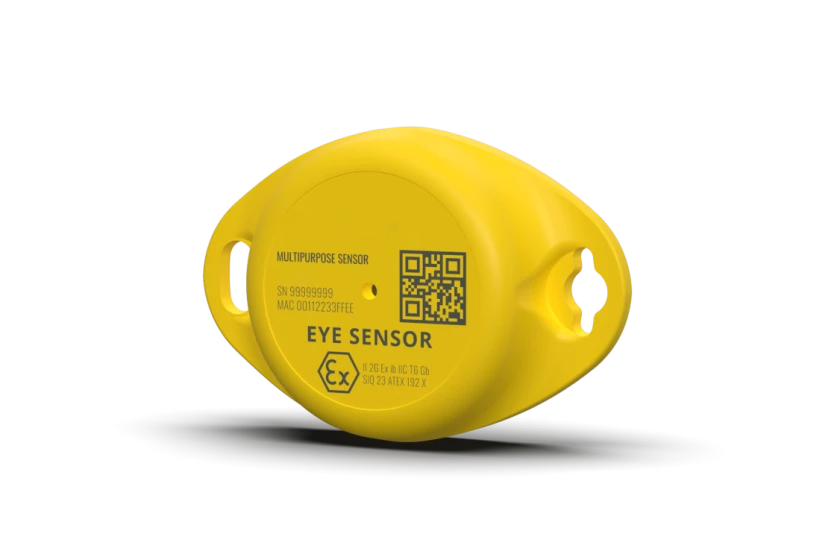
Evaluate orientation, movement and state capabilities against the exact model and hazardous-area evidence. Sensor suitability does not approve the gateway or complete installation. Site classification and jurisdiction review are required.
Share an anonymous unit scope, blind count and turnaround window to request a review of suitable gateway and sensor options. Configuration and deployment fit remain subject to assessment.